- calendar_today August 16, 2025
.
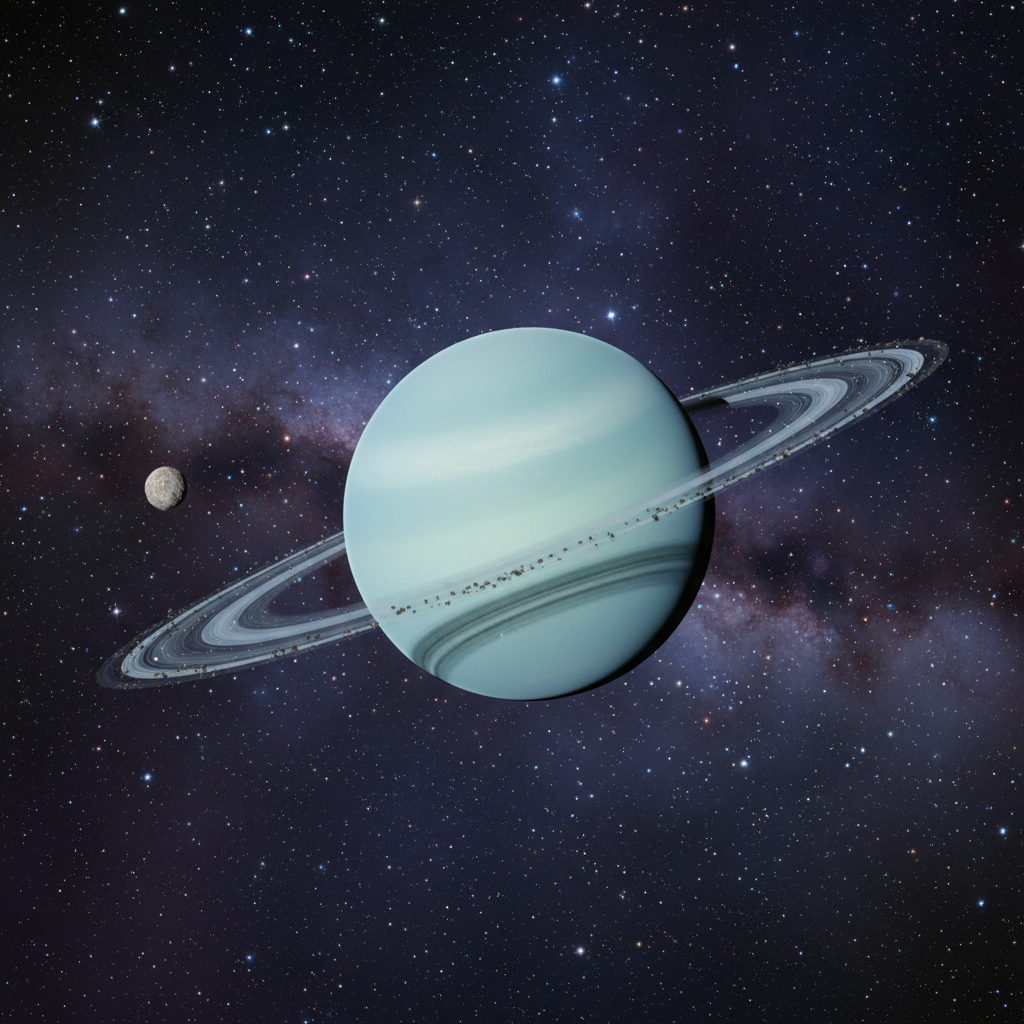
An unknown moon has been spotted around the planet Uranus. The discovery, made by astronomers using NASA’s James Webb Space Telescope (JWST), was recently reported in a preprint that has not yet been peer-reviewed or published in a scientific journal. As many as eight new moons are known to orbit Uranus, and astronomers continue to look for more.
Uranus’ known moons are an intriguing lot, and now Webb has discovered yet another hidden moon around the ice giant, as researchers confirm the finding has been made. The discovery increases the number of known Uranian moons to 29. But there are thought to be many more waiting to be discovered.
“The new moon was first noticed on February 2 by astronomers in a series of images that each lasted 40 minutes,” according to a NASA release. “We originally used long exposures to find the faintest rings around Uranus with Webb. In that search, we found that a tiny moon was hiding in our images, too.”
The discovery adds to the mysterious assembly of icy worlds around Uranus. With this addition, Uranus now has 29 known moons. The smallest of the new moons is a tiny object that measures just 6 miles (10 km) wide, which is considered the smallest natural satellite known to orbit Uranus.
The moon remained hidden in previous observations, possibly because it is so small, and because Uranus is circled by a bright ring system. The planet’s large moons are easier to see, but the dim glow of Uranus’ rings probably hid the new moons from previous spacecraft and telescopes. “It’s in the immediate neighborhood of Uranus’ rings and probably formed in that vicinity,” said Maryame El Moutamid, a senior scientist in the Southwest Research Institute’s Solar System Science and Exploration Division in Boulder, Colorado. She is also principal investigator of one of Webb’s programs, called Uranus’ Rings and Inner Moons, which was designed to study this system.
Temporary Name S/2025 U1
Webb is not only detecting new Uranian moons but also providing clues to the formation of this mysterious world’s ring system. Some of these small moons may even share a common origin with the rings. “This could mean they were born from the same ancient collision or disruption event,” El Moutamid said. “The new moon is so tiny that we’re just now able to spot it,” El Moutamid said. “This is where the power of Webb comes into play. Webb can see in the infrared part of the spectrum, where these objects can appear fainter, and its sensitivity is allowing us to make these discoveries.”
Webb, which is operated by NASA in partnership with the European Space Agency and the Canadian Space Agency, has been providing new views of Uranus’ rings, weather, and atmosphere as part of this program, called Uranus’ Rings and Inner Moons, which is run by El Moutamid.
Astronomers have a mystery on their hands with Uranus’ system of small inner moons. Uranus is known to have five major moons that can be seen with a small telescope: Miranda, Ariel, Umbriel, Titania, and Oberon. In addition, these planet also has a collection of small satellites. The object spotted by Webb now becomes the 14th small moon in that inner system.
Uranus has more of these small inner moons than any other planet, and yet they are tightly clustered together with their orbits perilously close to crossing. Somehow these satellites have stable orbits, and scientists think they may be acting as shepherd moons that help maintain Uranus’ narrow rings.
“This is a very exciting find,” said Scott Sheppard, an astronomer at the Carnegie Institution for Science who is not part of the new study. He discovered a moon orbiting Uranus with Webb last year, and another in 2024, and he called the new object “even more exciting” because it appears to be closely associated with Uranus’ inner ring system. “We can only see this object now because Webb is sensitive enough to detect it,” he said.
Matthew Tiscareno of the SETI Institute, who is the co-principal investigator in the Webb Uranus project, was also quoted in the news release, and he said: “The discovery also blurs the line between what is considered a moon and what is part of the ring system. Their complex inter-relationships hint at a chaotic history.” Tiscareno added that this newly detected moon is also smaller and fainter than the smallest known Uranian inner moons, suggesting more satellites remain hidden.
Before Voyager 2’s historic visit, only five moons had been observed, with the first being discovered in 1787. Voyager 2 went by in 1986 and added 10 more, which were between 16 and 96 miles (26 and 154 km) across. Another 13 small moons have been discovered since, first by ground-based telescopes and later by the Hubble Space Telescope. All of those are between 8 and 10 miles (12 to 16 km) wide, and as dark as asphalt. Inner moons are thought to be made of ice and rock, while the outer moons beyond Oberon are suspected to be captured asteroids.