- calendar_today August 18, 2025
As a leading authority in graphics tech, Nvidia is pursuing AI integration to transform how games operate. Nvidia’s high-performance GPUs are renowned for their ability to produce impressive graphics, but the company has launched its experimental G-Assist AI technology.
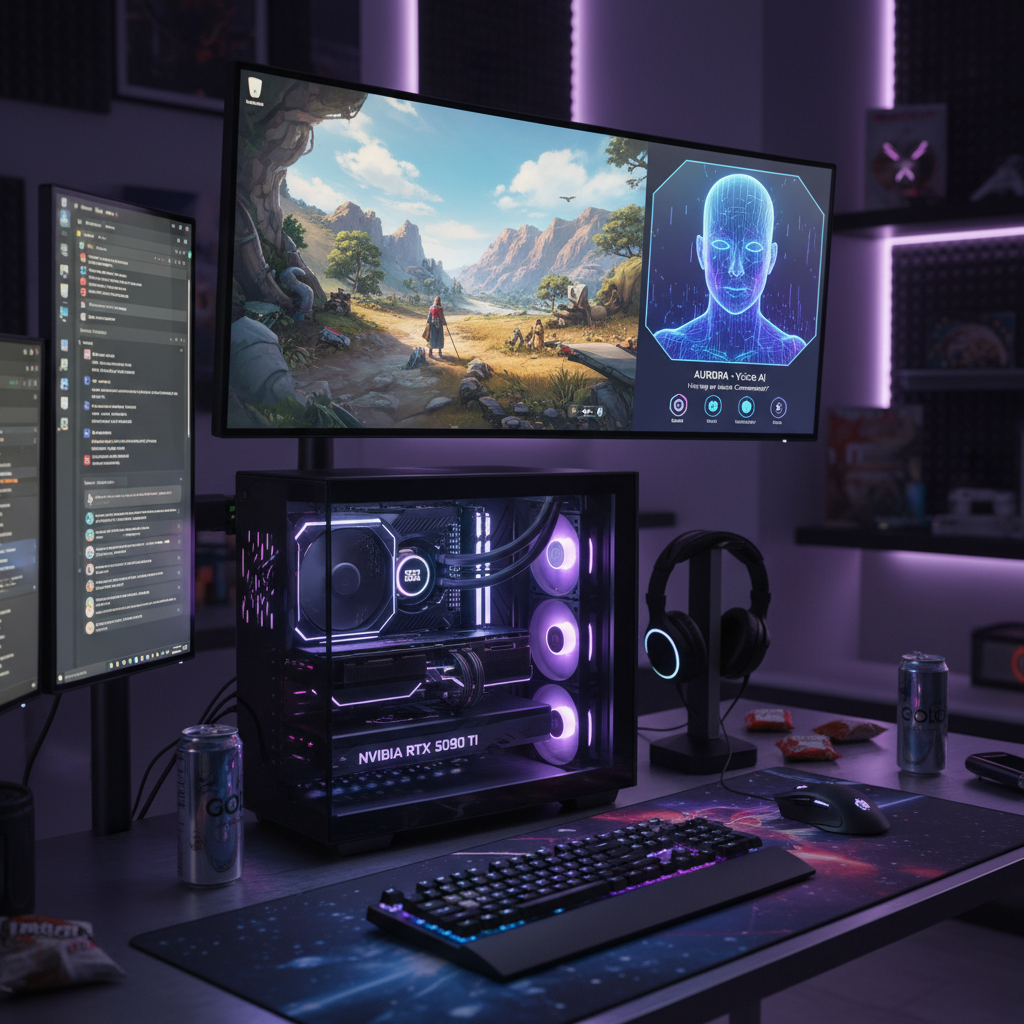
The locally operated tool works to improve PC performance and revolutionize gaming experiences while showcasing advanced human-computer interaction possibilities. Through an on-screen overlay in the Nvidia desktop application, users can communicate with an AI assistant through text and voice commands, which broadens system interaction beyond standard monitoring and transforms gamers’ hardware-software interaction.
Unveiling G-Assist’s Capabilities
G-Assist offers multiple features that work together to enhance the overall gaming experience. The AI allows users to ask general inquiries, including questions about DLSS Frame Generation functionality, and receive informative, AI-driven responses. The AI demonstrates greater capabilities by managing particular system-level configurations. Gamers achieve real-time system operation analyses through G-Assist activation, which includes dynamically created data charts to represent performance metrics.
The AI system enables users to modify game settings and switch features on and off, which leads to better automated optimization results. G-Assist helps performance enthusiasts by providing GPU overclocking capabilities along with predicted performance improvements while making a normally complicated procedure straightforward.
Limitations in Current Implementation
The public release presents exciting features but does not match the higher level of integration seen in last year’s demonstrations, where G-Assist functioned as an in-game helper. This more immersive level of integration is presently limited to a small selection of titles, with Ark: Survival Evolved being a key example.
Expanding Functionality with Plugins
Through third-party plug-in support, Nvidia has expanded G-Assist functionality. The AI assistant establishes communication links with devices from Logitech G, Corsair, MSI, and Nanoleaf to control dynamic thermal profile adjustments and LED lighting synchronization, which expands its control beyond basic system settings.
Hardware and Performance Requirements
With “AI laptops” transforming the PC market, Nvidia highlights desktop systems with dedicated GPUs for their built-in AI processing power. Nvidia’s G-Assist tool stands apart from cloud-based AI tools because it uses local operation through the processing capabilities of GeForce RTX graphics cards.
G-Assist uses a small language model that operates locally to achieve both quick response times and improved privacy, according to Nvidia. The standard text version uses 3GB while voice control requires an additional 3.5GB for a total storage requirement of 6.5 GB. To operate G-Assist need a GeForce RTX 30 or 40, or 50 series graphics card having at least 12GB VRAM. The system performance depends on the GPU’s capabilities, and future updates will add support for laptop GPUs.
Balancing Local Processing and Demands
Running G-Assist locally on the GPU entails certain benefits along with several challenges. The execution of local processing presents several advantages, including enhanced privacy protection and minimized response time, thereby enabling faster communication. However, it also introduces performance considerations. GPU utilization showed a significant rise when G-Assist was engaged during RTX 4070 tests.
The process of the AI generating a response requires computational resources, which can affect other tasks running at the same time, especially resource-intensive games. Playing Baldur’s Gate 3 at full settings resulted in frame rates falling by about 20% when G-Assist was active. G-Assist may worsen performance bottlenecks on systems that operate close to their maximum capacity. G-Assist functions more effectively away from demanding games, though heavy usage requires a powerful GPU for consistent performance.
The experimental status of G-Assist manifests through its sporadic performance issues, together with debugging problems. Users should continue manually tuning their system and game settings because it proves to be more effective for most individuals at this time. G-Assist marks a major advancement in utilizing AI processing capabilities of gaming PCs, which suggests GPUs will soon deliver richer interactive experiences.
Advancements in GPU technology are making it increasingly feasible to combine high-end gaming with complex AI models through seamless integration. Nvidia’s G-Assist currently offers an intriguing but developing preview of AI-enhanced gaming potential.