- calendar_today September 1, 2025
Ukraine’s 58th Separate Motorized Infantry Brigade says it’s destroyed two bridges in Russia’s Belgorod region in a high-stakes attack using low-cost first-person-view (FPV) drones.
The strikes targeted stockpiles of Russian mines and ammunition stashed under two bridges near the border with Ukraine’s Kharkiv region.
“Used by Russian Armed Forces as a warehouse”
In a statement, the brigade said the two bridges had been “used by Russian Armed Forces as a warehouse” for ammunition as well as “means of material support.” The Russian military had also mined the bridges in preparation for blowing them up, should Ukrainian forces launch a surprise attack.
Both actions fit with Ukraine’s destruction of several bridges leading to Kyiv in February 2022 in a bid to slow the Russian advance. It seems that Ukrainian forces have now turned this tactic on Russia in Belgorod.
Suspicious Activity Leads to Discovery
The 58th Brigade became suspicious of the two bridges after spotting “increased activity” around one of them. Standard reconnaissance drones proved unsuitable for monitoring under the bridge without the risk of losing signal.
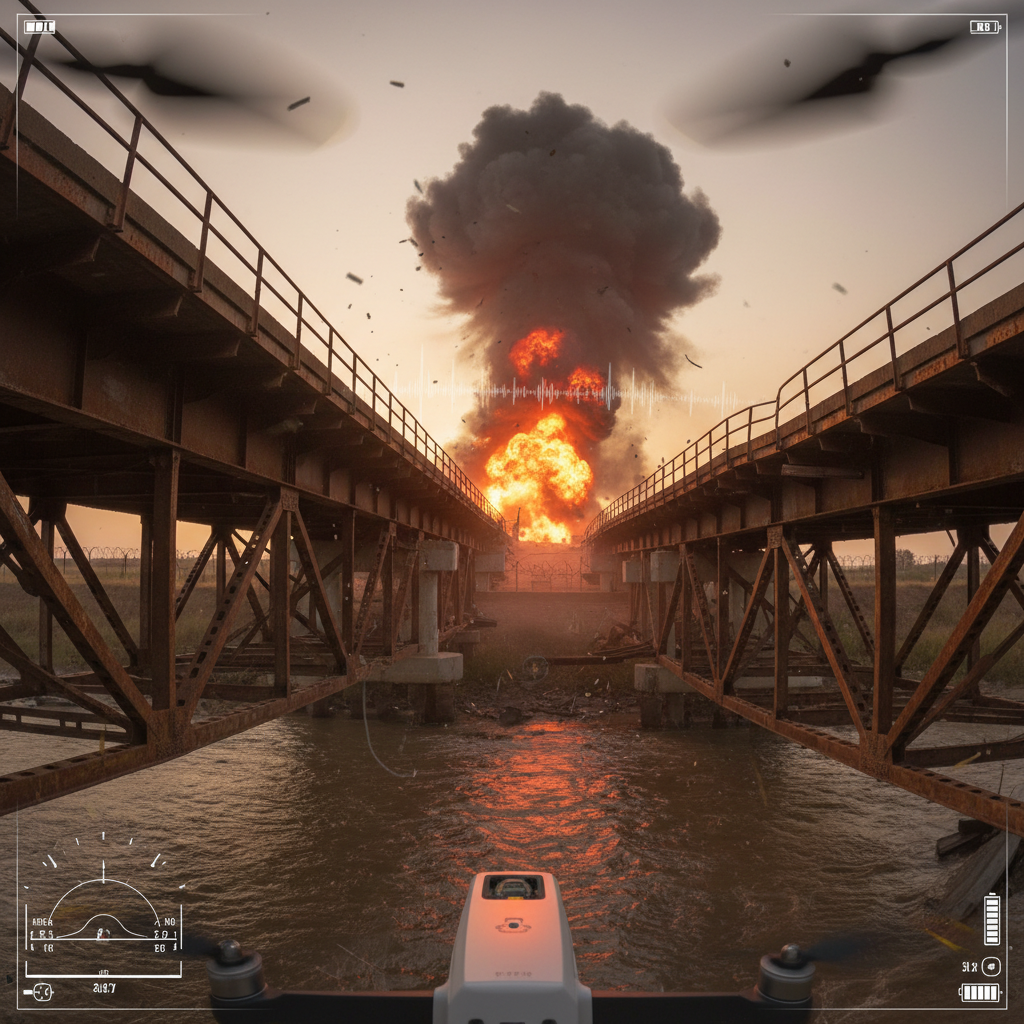
The brigade therefore deployed an FPV drone equipped with a fiber optics cable to inspect the area. Its operator quickly found an entire stockpile of anti-tank mines and other ammunition stored under the bridge. “We saw the mines, and we struck,” a brigade representative told CNN.
Videos released by the unit show the drone approaching the bridge. It then spots the hidden ammunition before detonating in a massive explosion. A second camera, placed on the ground nearby, captured the blast from a distance.
CNN geolocated the bridge to the Belgorod region of Russia, just across the border with Ukraine’s Kharkiv region.
Attacking Bridges with Drones
The unit then went on to find the same was true of another bridge nearby, again finding mines and ammunition. It sent a second drone, which also triggered a powerful explosion. “(We) saw an opportunity and took it,” the brigade said.
The successful operation marks the first time Ukraine has used drones to destroy bridges in Russian territory, rather than the other way around. More significantly, the drones used to do so cost between 25,000–30,000 Ukrainian hryvnias each, or roughly $600–$725. That is a tiny fraction of the cost of most high-tech weapons.
Throwing It All Away?
Ordinarily, Ukraine would need to use an expensive guided missile or precision-guided bomb to destroy bridges at such a distance. It has in the past used U.S.-supplied HIMARS rocket systems to attack infrastructure in Russia’s Kursk region. The launchers cost millions of dollars, while each rocket used is in the tens of thousands. A few thousand hryvnias worth of FPV drones was therefore an unusual and resourceful approach.
Cheap yet Effective
FPV drones have already played an outsized role in the fighting in Ukraine. Last month, for example, small drones smuggled into Russian military airfields were used to damage or destroy several aircraft.
Military analyst Mykola Bielieskov noted to CNN that operations like these demonstrate “how even modest technology can achieve outsized results when used creatively.” FPV drones offer Ukraine a relatively cheap way to conduct operations deep inside Russia without having to use valuable Western-provided munitions.
Boost for Ukraine?
The strikes on Belgorod come at a time when Ukraine is under pressure on several fronts. The Russians have been slowly grinding forward in the east of the country. At the same time, Moscow has continued its near-daily barrage of missile and drone strikes on Ukrainian cities. It has also upped the ante with its attacks, including a June strike that hit the Dnipro river with an artillery strike.
President Vladimir Putin has also made clear he is in no mood to discuss a ceasefire and will continue the offensive. Against this backdrop, the bridge attacks provided a welcome distraction for Kyiv, which has struggled to generate good news in recent weeks.
Russia has so far not officially commented on the attack. It has reportedly failed to get a cross-border package of sanctions approved by the European Union. Moscow is likely to feel the pain of the destroyed bridges, which will complicate its logistics in the Belgorod region and disrupt supply lines to Russian forces near the Ukrainian border.
Out of Necessity
For the Ukrainian military, the Belgorod attacks show a broader trend. When supplies from the West are limited and faced with an opponent who often has the numbers advantage, Ukraine has been forced to improvise.
Modified FPV drones, often cobbled together with consumer parts and then modified by volunteers, have become one of Ukraine’s most effective weapons systems.
“The value of these drones cannot be overstated,” a 58th Brigade representative told CNN. “They allow us to achieve results that would otherwise require weapons we don’t have.” In an ongoing conflict, Ukraine’s ability to adapt and strike creatively in Russian territory could yet help it neutralize some of Moscow’s battlefield advantages. For now, two destroyed bridges in Belgorod serve as a stark reminder that small and cheap weapons can still have strategic consequences.