- calendar_today August 20, 2025
.
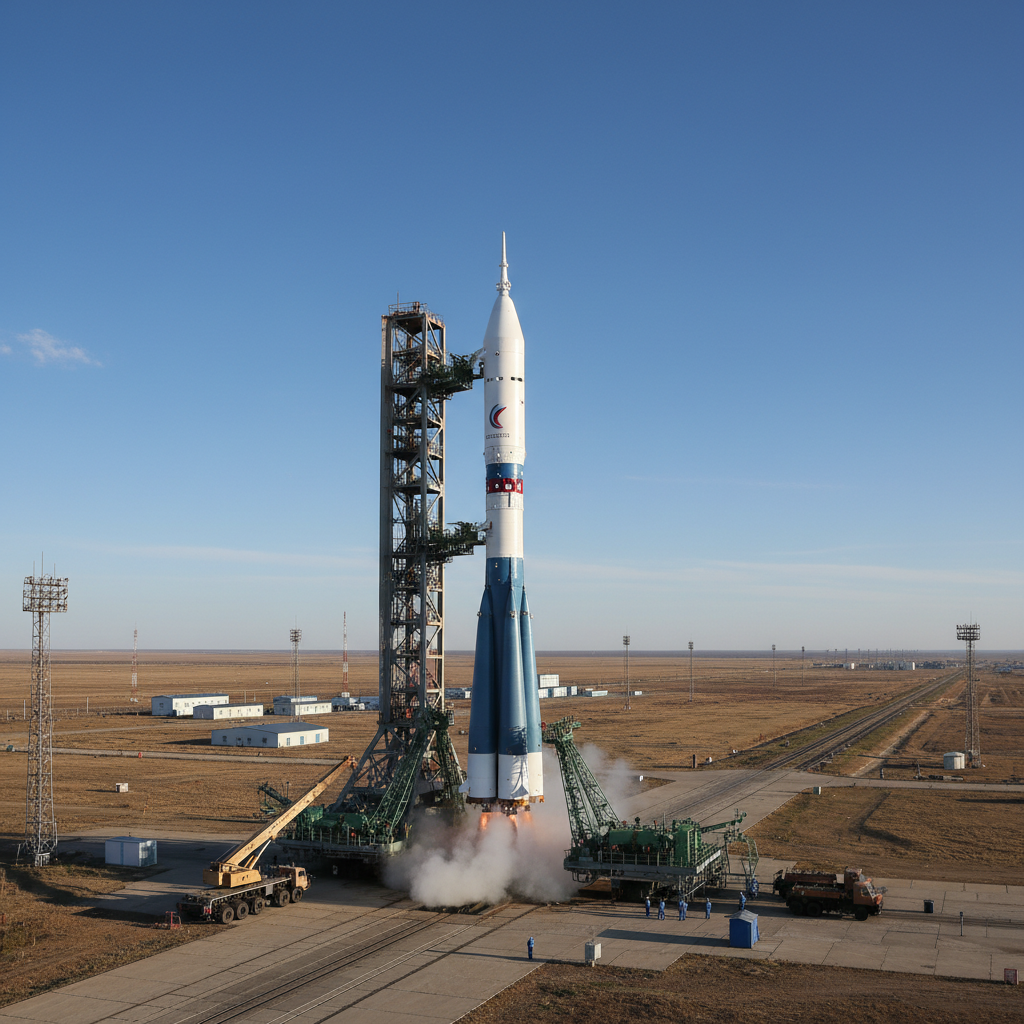
Russia is reportedly gearing up to put its next rocket, the Soyuz-5, into space before the end of this year. Dmitry Bakanov, the director of Roscosmos, Russia’s space agency, said in an interview this week with state-owned news agency TASS that the program is on track for December liftoffs.
“Yes, we are planning for December,” he said, though he also added that “we have not set a concrete date, we are preparing for this.” The rocket will take off from the Baikonur spaceport in Kazakhstan, and if all goes well, it will be the first flight test of a vehicle that has been in development for more than a decade. Roscosmos plans for a series of test launches, but does not expect to have Soyuz-5 in service for several years; current projections say operational use may not begin until 2028.
Soyuz-5, also known as Irtysh, is not a clean sheet design. It is a somewhat larger derivative of the Zenit-2 rocket, whose design dates back to the 1980s and is the product of the Yuzhnoye Design Bureau in Ukraine. Zenit was assembled in Ukraine, using Russian-supplied RD-171 engines. The Zenit rocket was a limited collaboration in post-Soviet space technology, one that Russia effectively ended after the invasion of Ukraine in 2022. In late 2023, Russia destroyed the Ukrainian facility that once assembled Zenit.
Soyuz-5 is a larger Zenit rocket, but with a Russian-made counterpart. Yuzhnoye’s work on the original Zenit has been largely recast into the Soyuz-5, which is a purely domestic design in terms of its key components. For Russia’s political leadership, the fact that it was necessary to completely reconfigure the Zenit is as much a win as the end of the collaboration itself. Moscow was able to cut a thread that had been a dependency for more than three decades, while also sidelining the Proton-M rocket in the process.
A Medium-Lift Bridge
Soyuz-5 is a medium-lift launch vehicle, at least in terms of its advertised capabilities. It has a payload capacity of around 17 metric tons to low-Earth orbit (LEO), a step up from Zenit that is largely attributable to slightly larger propellant tanks. Most importantly, though, is the rocket’s RD-171MV engine, the newest iteration of one of the most powerful rocket engines in operation.
RD-171MV is a direct descendent of work on the Energia program, a Soviet space launcher from the 1980s used to power the country’s ill-fated space shuttle, Buran. The most obvious difference between the Soyuz-5’s RD-171MV and its predecessor in Zenit is the lack of Ukrainian parts. The RD-171MV is a kerosene-fueled engine with liquid oxygen that puts out a little over 1 million pounds-force of thrust, which is more than three times the amount generated by NASA’s Space Shuttle main engine. It is currently the most powerful liquid-fueled rocket engine in service.
Soyuz-5, by contrast, is an expendable rocket. Its nearest competitors are, on the whole, newer designs built around the idea of reuse, most notably SpaceX’s Falcon 9 rocket. This will have implications for the rocket’s long-term viability in the international market, even if it does land in service.
On the domestic front, however, Soyuz-5 has a less crowded field. Russian launch services have been on something of a back foot since the 2010s, as SpaceX and Chinese providers have offered a lower-cost and more flexible alternative. Russia still operates Soyuz-2 rockets for crewed launches and its Angara family for heavier payloads, but neither has made much of a mark internationally. Soyuz-5 may be able to buck the trend, though the barrier to entry will be high.
At the same time, the funding available for a new, reusable rocket from Russia has been limited by war costs and sanctions; in short, developing one from scratch has proven a challenge. Amur, also called Soyuz-7, was to be the answer. The concept for Amur is a reusable first stage built around methane-fueled engines. In theory, a fully reusable Amur rocket could compete with SpaceX in terms of price, and represents an answer to Russia’s long-term needs for a new launch vehicle.
Amur has run into repeated delays, however. From current indications, it will not be operational until at least 2030. Soyuz-5 is its de facto replacement for the time being, a bridge to future development that makes use of mostly legacy technology to keep the Russian space program on track.