- calendar_today August 14, 2025
.
The state of U.S. electric vehicle (EV) adoption is growing murkier as sales figures falter and the limits of charging capacity are exposed. After more than a year of consistent monthly increases, EV sales are now in contraction territory. Genesis and Volvo, among others, have already experienced consumers rejecting their EV lineups, and are now backtracking on their EV plans.
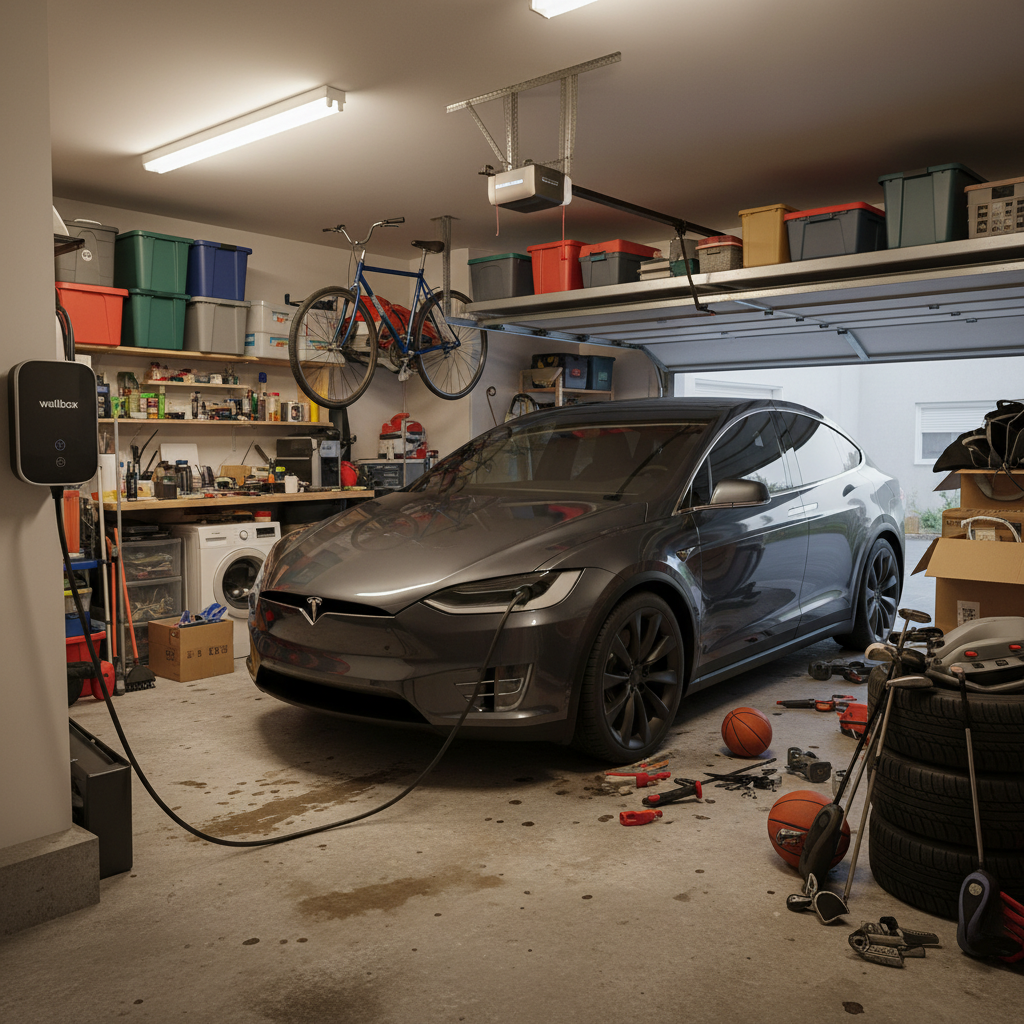
New presidential administrations have already added uncertainty in the form of fewer subsidies and a rollback on vehicle pollution standards. This has reduced the value of federal incentives available to EV buyers. However, says a new report from EV industry analyst Sam Abuelsamid of Telemetry, the biggest challenge to EV adoption in the U.S. may be the one parked in your driveway.
EV Charging Speed Bumps: Where You Park
Sam Abuelsamid, Vice President at Telemetry, has written a new market research report on electric vehicles in the U.S., titled “Electric Vehicle Outlook: U.S. Plug-In Car and Truck Sales, Market Shares, Incentives, Policy and Charging Infrastructure”. In it, Abuelsamid drills down into a subject that has been in the background of many other EV surveys over the years: where you park your car at home.
Interest in fast charging has grown steadily, driven in part by high-profile government and corporate funding and an increasing number of destinations. However, these chargers account for only 20 percent of total electricity used by the EV fleet. The bulk of charging, 80 percent, is done at home, plugged into an AC charger.
An existing study by the National Renewable Energy Laboratory (NREL) found that the number of single-family homes (SFS) capable of charging is 42 percent of the total, or about 31 million homes. However, that figure could be nearly doubled, to 68 percent of the total or more than 50 million homes, if consumers uncluttered their garages and parked their vehicles in a different spot.
Abuelsamid emphasizes in his report that “90 percent of all houses can add a 240 V outlet near where cars could be parked.” Most of the remaining 10 percent are on homes with older wiring that will be prohibitively expensive to upgrade, especially for units in multi-dwelling homes, such as apartment buildings. The number of single-family homes with chargers, then, could be expanded to more than 72 million homes with a concerted effort to rewire homes that currently have neither.
This total is greater than even the upper end of Telemetry’s 2035 EV sales projection (57 million), and far in excess of EV penetration achieved to date. However, that capacity in existing garages may be highly theoretical. The same NREL study found that 33.9 million homes with garages and parking spaces would need a major electrical upgrade in order to support a level 2 charger. Adding a new 240 volt outlet with a capacity of at least 30 amps is no small task, and could mean rewiring from the circuit box, or even replacing the entire panel, which can cost thousands of dollars.
A major piece of the value proposition for EVs is their low operating cost when compared to gasoline vehicles, especially over the long term. However, few homeowners buy an EV with the expectation of spending thousands of dollars in electrical upgrades before installing the charging cord. Add in the costs of an actual charger, and the cost of ownership for an EV begins to look much closer to that of a gasoline-powered car.
Multi-Unit Dwellings Lagging
The multifamily home market, which accounts for the remaining 23 percent of U.S. households, is where the challenges are particularly acute. In these buildings, individual homeowners are unlikely to have the choice to add chargers without the permission of an owner or management company, and are often met with resistance.
The economics are even less certain. Many of these buildings would also need electrical panel upgrades in order to support chargers, and the upfront cost to the residents, even in cooperative buildings that own and manage themselves, could be measured in millions of dollars for a single building. A developer who is building new units or a municipality is more likely to invest in new infrastructure, but that is a highly local, project-specific decision.
The payback for an owner of a building with existing units is less clear. In addition, a standard new charger, which operates at 240 volts, requires new wiring from the power panel in most cases, and must be installed where a car can be parked near it. In a new development, planners can orient parking and wiring simultaneously. However, in an existing structure, this may mean cutting into concrete to re-route wiring. Unlike single-family homes, the residents of multifamily buildings are also less likely to qualify for federal or municipal incentives to subsidize the cost of installation.
This has kept adoption in the multihousing market lower than single-family homes. There are an estimated 1 million EV owners in these structures, but only 11 percent have a spot where they can plug in near their parking space. Some states are enacting rules that require developers to make a portion of parking spaces EV-ready, in the range of 20 to 25 percent. Even these requirements will not cover the entire market by 2035, and Telemetry’s report projects only 6.7 million to 11.4 million charging-capable spaces in multifamily dwellings will be added by that year.
That would leave a significant gap to bridge through public charging, which will be a necessary stopgap for the estimated 8 million or more EVs in these spaces without at-home charging capability. While some share of these residents will eventually have chargers added, the total number of chargers for the EV population in these homes will remain low relative to single-family homes.
Charging Infrastructure Challenges
Public charging, of course, is where EVs in the U.S. are likely to need to lean hardest. Despite the capacity in SFS homes that could in theory support EV charging, there will be a need for additional infrastructure in the 2035 time frame.
Telemetry’s report estimates that even with the 11 million or more SFS owners that will have charging, an additional 11.7 million to 14.3 million EV owners who own houses will use public charging in 2035. On top of that, 7.8 million to 8.1 million EV owners in multi-unit dwellings will also use public charging, for a total of 19.5 million to 22.4 million U.S. EV owners who will regularly use public charging.
That’s a significant portion of the projected total EV fleet, and even more significant given that a lower proportion of those drivers will charge exclusively using public chargers. Filling this gap with sufficient infrastructure is already a challenge that EV and charging companies are facing. Expanding utility infrastructure has its own set of problems, as power companies are already straining under the needs of rapidly expanding data centers, which use a considerable amount of electricity to power their AI servers.
Supply and demand for DC fast chargers could be a serious issue if adoption takes off more quickly. Given the cost and scale of installation for public chargers, new entrants could be slow to get into the game, creating a situation where demand outstrips supply, especially as more new EV models continue to come to market in the U.S.
EV Sales Lost Momentum in September
For the moment, the picture of EV adoption in the U.S. is less bright than the headlines would suggest. On paper, the number of SFS in the U.S. that could be supporting EV charging with relatively little effort is a large portion of the housing stock. However, cluttered garages, the high cost of electrical upgrades, and the difficulties faced by the multifamily sector are all likely to put a cap on adoption in the U.S. in the near term. Even public charging, with significant expansion in the future, will struggle to meet demand in the coming decade.